

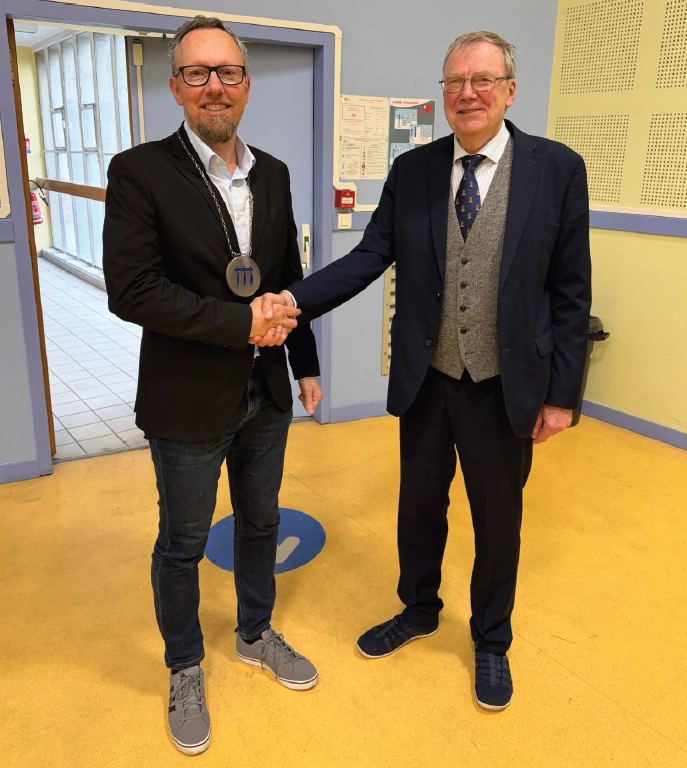
Mr Erik Muijsenberg was recently appointed the 34th President of the International Commission on Glass (ICG).
Mr Muijsenberg is a well-known and popular figurehead of the industry. In his current role as Group Business Development Director of the Czech Republic’s Glass Service, he has delivered numerous papers at industry events around the globe.
He has been involved in the ICG since 1990, when he attended his first annual conference in Düsseldorf in 1990 while working at the Netherlands’ TNO Glass. Since then, he has attended most ICG Congresses and annual meetings worldwide, from Madrid in 1992 to Shanghai in 2016.
Mr Muijsenberg’s formal path toward the Presidency began in 2022 when the call for a new president-elect was opened. He eventually took over the role during an ICG Steering Committee meeting hosted in Istanbul, with his first official annual meeting in the position taking place during the joint ICG and Korean Ceramic Society conference in Seoul in 2024.
Mr Muijsenberg was delighted to accept the role, saying: “I am deeply honoured and genuinely flattered to have been asked to take on the role of President of the International Commission on Glass. “Considering the many outstanding and internationally respected Professors who preceded me, I was initially surprised that so many National Participating Organisations (NPOs) and member countries recommended me for this position.” He added that he believed he was invited to consider the Presidency because of his network and long‑standing role as a bridge between academia and the glass industry.
Mr Muijsenberg became active in ICG Technical Committee 21 early in his career, which focused on furnace modelling, design, and operation. TC21 played a crucial role in validating Computational Fluid Dynamics (CFD) models for glass furnaces, which made modern furnace design significantly more reliable.
Via Round Robin tests the leading organisations and glass producers exchanged data and compared model results. This has led to reliable simulations models which predict glass melting furnace behaviour before a new one is constructed. Mr Muijsenberg remarked: “The new generation of oxy-gas furnaces, hybrid melters or large electric melters would probably not be possible to build in an optimal and reliable way if we would not have validated furnace simulation tools today.”
Vision for the ICG
As President, Mr Muijsenberg said his priorities include advancing decarbonisation strategies for glass production, strengthening the role of women in glass, and engaging young professionals to secure the long‑term future of the ICG.
Those themes shaped his first major appearance as President at the ICG conference in Lyon in April, where he was officially appointed to the role.
Organised by the French Glass Association (USTV) in collaboration with the European Society of Glass (ESG) and the ICG, the event attracted 540 professionals, even despite a parallel ACerS meeting taking place in the United States. Mr Muijsenberg delivered the opening remarks and a plenary lecture on decarbonisation. He said: “I strongly believe in the future of glass and in our ability to decarbonise glass production without undermining its economic viability. As ICG President, I now have a broader platform to encourage collaboration and bring together the combined strengths of academia and industry. “Glass plays a crucial role in reducing global carbon emissions. Buildings remain the largest contributors to energy related greenhouse gas emissions in Europe, accounting for approximately 33% in 2023, and glass windows and insulation are essential for improving their energy efficiency.
“Furthermore, renewable energy generation relies heavily on glass, from solar photovoltaic panels to wind turbines. In this sense, glass is vital for the future of humankind.”
ICG’s role
Mr Muijsenberg joins a notable institution in the industry. Established in 1933, the ICG helps develop international cooperation between glass technologists and researchers, and the International Congresses, held every three years, present original contributions from over 30 countries worldwide. They typically attract around 1,000 glass scientists and industry professionals. (Pic 1) The ICG will hold its Annual Meeting in Brazil in September 2027, followed by its next international congresses in Japan in 2028 and the Czech Republic in 2031. The organisation is also planning a special ICG congress in Italy in celebration of its 100th anniversary. The first meetings of the ICG took place in Italy in 1933 under the leadership of Professor W.E.S Turner. As ICG President, Mr Muijsenberg leads the ICG
Board, including the Vice President, Treasurer, Chair of Technical Committees, and Executive Secretary. The Board meets regularly through Steering Committee meetings and works closely with the ICG Council, which represents over 30 National Participating Organisations worldwide.

Pic 1. The first International Congress in 1933 in Milan.
As part of his many responsibilities, Mr Muijsenberg aspires to grow the ICG by expanding national participation and strengthening the Associated Member Company (AMC) programme. Many glass producers operate globally, and AMC membership allows direct involvement beyond national organisational boundaries. The ICG’s Steering Committee asks the AMC to highlight interesting topics in order to help the scientific members of the ICG decide what they can work on. Furthermore, the increase in financial income will allow the ICG to initiate pre-competitive research action, or search for funding from larger groups such as an EU funding programme.
Mr Muijsenberg aims to get more companies interested in joining as an AMC member and will focus on the TC30 initiative on decarbonisation to attempt to draw in more members.
The ICG is the only truly global organisation that brings together glass science and industrial practice. Leading researchers and major glass companies actively participate in its Annual Meetings, Congresses, and 29 specialised Technical Committees covering topics from furnace technology and glass compositions to coatings, biotechnology, and sustainability.
Most national glass associations are members of the ICG as National Participating Organisations, which ensures structured international cooperation.
The organisation has always played a vital role in linking glass science to industrial and societal needs. Glass is essential for pharmaceutical packaging, global communication through optical fibres, renewable energy technologies, safe transportation, buildings, medical applications, and digital infrastructure.
It was also crucial during the COVID-19 pandemic. Glass packaging is essential for the safe containment and worldwide distribution of vaccines, and the pandemic’s outcome would likely have been very different without the work of the ICG Technical Committee 12.
Furthermore, glass is a hidden enabler of modern society: optical glass fibres form the backbone of global internet communication, support the rapid growth of artificial intelligence, and are increasingly used in next generation electronic and quantum technologies. Daily life depends heavily on glass, from smartphone displays and vehicle windscreens to energy efficient building glazing and insulation.
Mr Muijsenberg added: “Renewable energy technologies also rely fundamentally on glass, through solar panels and glass fibre reinforced wind turbine blades. “In medicine, bioglass enables bone regeneration and dental repair. In this sense, glass is indispensable to modern life—and to a sustainable future.”
Final reflections
Mr Muijsenberg said the glass industry faces a critical period as manufacturers work to balance decarbonisation with economic sustainability. He warned that around 75 container glass furnaces have closed worldwide over the past three years, adding that the industry must move quickly to prevent decline.
He said: “Glass production must become low carbon or carbon free, and we must prevent food and beverage packaging from shifting further towards plastic. “Many people are unaware that aluminium packaging contains plastic liners and that microplastics pose serious health risks. Glass remains the only truly inert packaging material, infinitely recyclable while conserving valuable raw materials. “It is produced from some of the most abundant materials found on Earth and, when manufactured using renewable (electric) energy, represents a genuinely sustainable and protective solution for what we consume.”
ICG Technical Committee 30 was established by Mr Muijsenberg to tackle decarbonisation, and he hopes to engage with the United Nations and local governments to help ensure that emission regulations are feasible, fair, and do not undermine industrial viability. He added: “Glass is essential to sustainable packaging, renewable energy, healthcare, communication, and advanced technologies. “We truly live in the Glass Age, and together we must ensure it has a sustainable future.”
Read the PDF News by clicking here


Customer Reviews
Thanks for submitting your comment!